
The local living Economy of the Piscobamba River Watershed Regenerative Bioregion

By Walter Moora

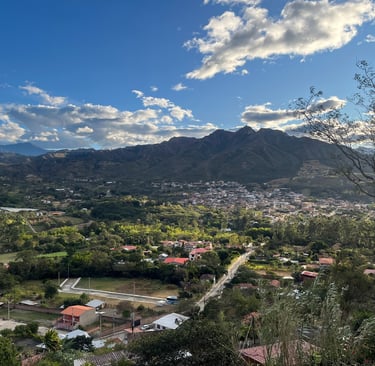
My dream, which I share with a small group in Vilcabamba, is to create a sovereign watershed. Tumianuma is a good start in this direction. As time goes on, there can be more and more communities that grow most of their own food. Eventually the watershed will be close to food self-sufficient. This would be our first step in becoming sovereign in food.

For quite a few years a small group has been meeting to design our watershed. It would include small scale entrepreneurship, organic farming, water management and retention. Socially we would include support for the elderly and needy and good education and activities for the children and youth.

To support all this we will need a new economic platform that keeps the money in the community. We do have a local digital coin that is part of Local Scale .https://localscale.org

LocalScale is a public benefit organization focusing on the development of resilient and sustainable local economies through the use of technology. However we did not launch it yet, as we felt that we had to create the right community environment that would support it.

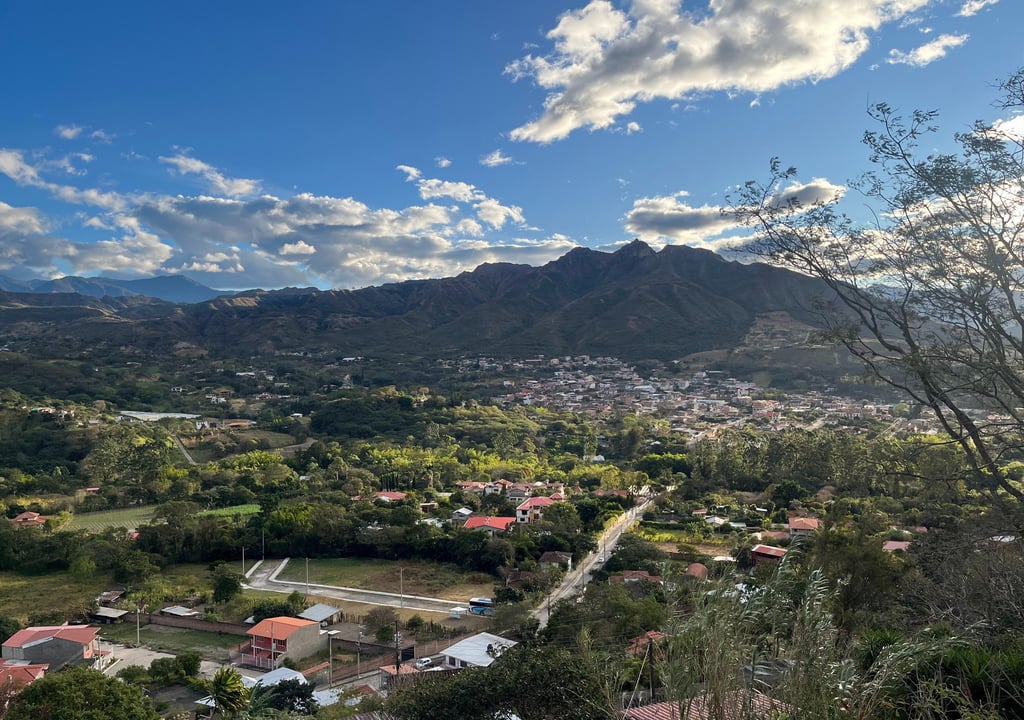
Personally, and I am sure that many would agree, humanities consciousness has changed so much that we do not need big government telling us how to run our lives. This is why the bioregion concept is taking off. We watch and see everything around us collapsing. Our little watershed, called the Piscabamba watershed is ideal for creating an island of light. Our dream is that there will be many islands of light around the world. Each one designed and suited to its own watershed or larger bioregion.
Vision

That the communities of the Piscobamba River watershed become self-sufficient, with human presence integrated in harmony and respect with Nature, conserving biodiversity and fostering a sustainable social and economic dynamic based on abundance and cooperation. We aim to become a replicable model for similar projects in the region.

To develop, finance, and implement regenerative and self-sufficient systems in the Piscobamba River basin, in order to address urgent environmental and social challenges Water cycle conservation, transition to renewable energy, health, natural construction, regenerative food sovereignty, education, local economy, ancestral knowledge revival, and environmental conservation.

Mision

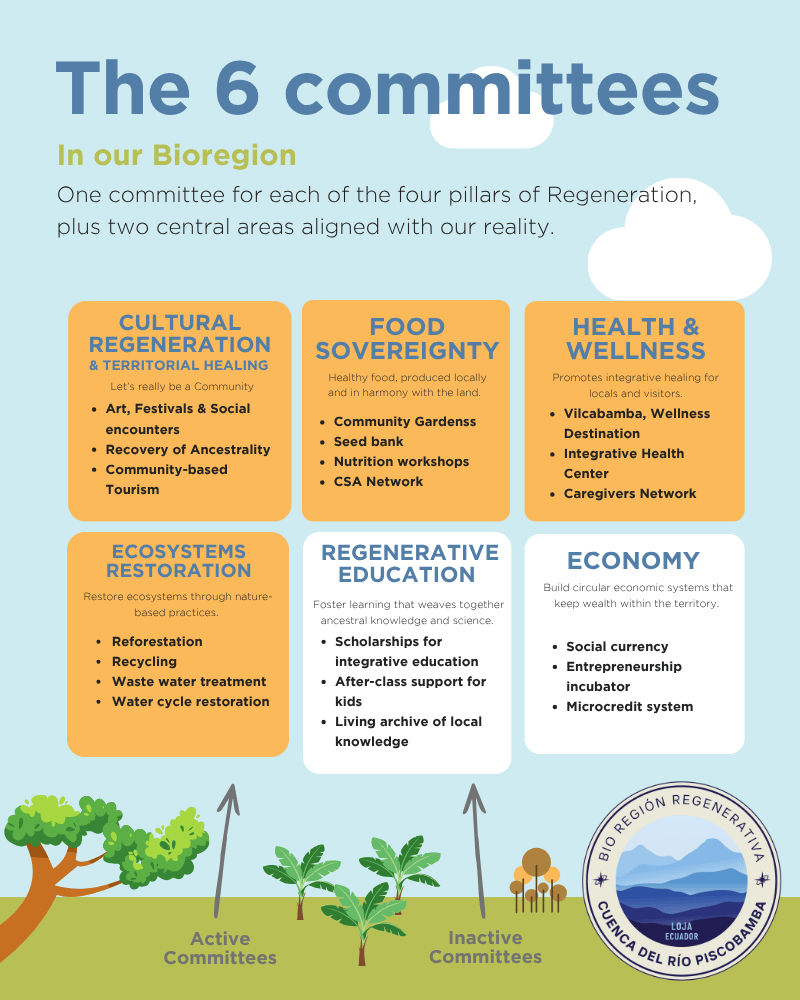
The Four Pillars of Regeneration

Inspired by the pioneering work of Joe Brewer and Fundación Barichara Regenerativa in Colombia, we want to organize the current and future projects around four interconnected pillars:

1. Regenerative Education

Empowering the next generation through accessible and integrative learning.

  • Low-Cost Integrative Education for Local Children – A community-based program offering holistic education that weaves together ecological literacy, cultural heritage, practical skills, and emotional intelligence.

  • Research and Communication on systemic ecosystems restoration and natural health, in cooperation with academic institutions.

2. Regenerative Economy

Building a circular, resilient, and community-rooted economy.

  • Social Currency. A local complementary currency designed to keep economic exchange circulating within the bioregion, strengthening community resilience and reducing dependence on external markets.

  • Community Gardens. Agro ecological food-growing spaces in Vilcabamba and Tumianuma, equipped with water harvesting, greenhouses, and regenerative infrastructure to improve food sovereignty and community integration.

  • Living Soils for Agriculture. A high-tech soil remediation program that restores degraded farmland using biological inputs, enabling farmers to transition from agrochemicals to regenerative practices like permaculture and Andean agroecology.

  • Local Entrepreneurship, Creation of Value-Added Products, and Community Kitchen. Training and microcredit support for locals to develop small businesses that transform raw agricultural goods into marketable products.

  • Micro-Hydropower for Energy Sovereignty. Small-scale hydroelectric systems installed in local streams to provide clean, reliable, and autonomous energy to households and community facilities, reducing reliance on the national grid.

  • Community-managed Tourism Project. A grassroots tourism model where local families host visitors in their homes and youth serve as cultural and ecological guides, generating income while sharing authentic heritage and values.

3. Regeneration of Natural Ecosystems

Restoring ecological integrity and closing resource loops.

  • Restoration of the Small Water Cycle through Permaculture
    Apply small earthworks to reactivate local hydrological cycles, increasing humidity, groundwater recharge, and climate resilience.

  • Water Conservation & Storage Systems. Capture and store rainwater in ponds, reservoirs, and infiltration canals during the wet season to ensure year-round water access for communities and ecosystems during the dry months.

  • Wastewater Treatment with Microorganisms. Implement low-tech, biological treatment systems that clean greywater and blackwater using natural microbial processes before safely returning it to the landscape.

  • Reforestation Programs. Restore native forest cover through community-led planting of indigenous species, enhancing biodiversity, soil stability, and watershed health.

  • Integrated Recycling Program. Foster projects that organize collection, sorting, and valorization of recyclable waste, creating local jobs and closing material loops while reducing pollution in the valley.

4. Cultural Regeneration & Territorial Healing

Nurturing holistic well-being, cultural identity, and intergenerational continuity.

  • Integrative Mental & Physical Health Center. Low-cost preventive, non-commercial care that blends ancestral Andean medicine with holistic wellness practices, empowering individuals to take charge of their health.

  • Nutrition & Cooking Workshops. Recover the use of diverse local ingredients, traditional preservation methods, and healthy cooking techniques to strengthen food culture and agro ecological production.

  • Art Therapy for Children & Youth. Provide creative spaces where young people explore emotional expression, identity, and connection through painting, music, storytelling, and movement.

  • Agroecological Seed Bank. Preserve and distribute native and heirloom seeds adapted to the region, safeguarding agrobiodiversity and supporting food sovereignty across Ecuador.

  • Recovery of Ancestral Construction Methods. Revive and adapt traditional building techniques—like quincha, adobe, and stone masonry—using local materials combined with new, low techs to create resilient, non-toxic, and culturally meaningful homes.

  • Community Art Gallery / Cultural Center. A physical and symbolic space to showcase local art, host performances, celebrate festivals, and transmit cultural memory across generations.

  • Autonomous Internet Network. Build a community-owned digital infrastructure that ensures communication resilience, data sovereignty, and access to knowledge—free from corporate or state control.

  • Community-Supported Agriculture Network. A bioregional network connecting local farmers with community members through seasonal subscriptions. This model ensures fair income for growers, strengthens food sovereignty, and rebuilds the sacred relationship between people and the land through shared risk.

The Bioregional Learning Center: Our Keystone

Following the vision articulated by Dana Meadows (1983) and expanded by Joe Brewer, our Bioregional Learning Center —“Centro de Saberes”— will serve as the living heart of the bioregion. It is meant to be a dynamic, evolving organism that holds the collective intelligence of the territory.
Its core functions include

Knowledge Integration
The core function of a Learning Center is to be an archive of ancestral wisdom, scientific research, historical activism, and technologies that have been tested in the local circumstances—whether they are currently in use, were abandoned in the past, or are being rediscovered. This living library becomes the reference point for all regenerative action in the bioregion, ensuring that efforts are grounded in both deep time and present innovation.

The idea is to train an AI Agent on the bioregion’s collective memory to make all that information instantly accessible to anyone starting projects under the Bioregional umbrella in the area.

Funding Integrity
One of the main functions of the Learning Center should be to organize a continuous Flow Funding system inside the bioregion to ensure that incoming funding is distributed in a transparent, mission-aligned way, and that recipients are responsible, committed individuals who are embedded in the community. Currently, most global funding for social and environmental causes is filtered through large NGOs that use the vast majority of resources for administrative costs, leaving only a trickle for grassroots actors. We envision a radically different model: 90% of all incoming funds go directly to project leaders on the ground, while 10% supports the Learning Center’s coordination, monitoring, and operational capacity.

Trust-based Governance
Rather than requiring complex legal structures to obtain funding, the Learning Center builds trust through personal relationships, shared history, and demonstrated integrity within a small, interconnected community. This reduces bureaucratic overhead and allows project leaders to focus their energy on implementation, not paperwork.

Collaborative Coordination
The Center serves as a regular forum where all project teams meet to align strategies, share challenges, co-design solutions, and respond collectively to external threats or opportunities. This ongoing dialogue fosters synergy, prevents duplication, strengthens the bioregion’s collective resilience and gives birth to a multi disciplinary systemic body capable of developing durable solutions to all types of problems.

person holding black and brown globe ball while standing on grass land golden hour photography

Planetary Network
The Learning Center also connects with other bioregional initiatives around the world—those more advanced in their journey and those just beginning. These relationships enable mutual learning, shared tools, and solidarity across landscapes, contributing to a growing planetary network of place-based regeneration.